LINEAR PERSPECTIVE
Objects appear to get smaller as they get further back in the picture space. So a tree in the foreground will appear higher than a similar tree in the background. We all know about the effect of looking along straight railway lines as they run towards the horizon – they appear to come to a point. You can also get this effect by looking along the length of a table with your eyes at table height. Not only, therefore, do objects get shorter in the distance, they also appear to get narrower.
So far so good, but it gets a bit trickier with roof lines – how do we know when the line should run uphill or downhill? A common mistake is to make part of the drawing or painting look as if it has been seen from eye level and the rest from a helicopter. An obvious example is when a chimney top is drawn from above and the roof from below. Try to imagine yourself standing before the building. Draw the nearest corner, then if the roof line is above your eye level it will appear to run downhill away from you and the ground line will appear to run uphill. If you are drawing on site hold your pencil horizontally in front of one eye, against the building as it were – shut the other, and you will be able to see the correct angle very easily. If you are looking straight on at a building, the top and bottom lines will be parallel with the top and bottom of your page.
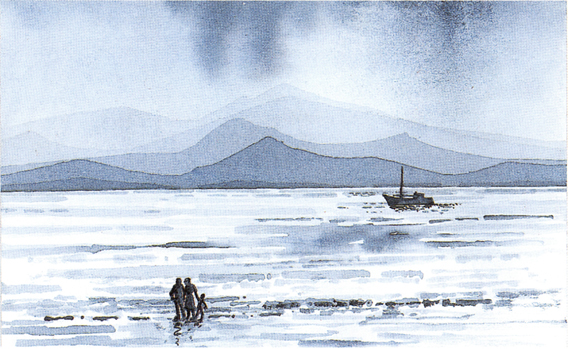
MOUNTAIN AND LOCH,
watercolour on thick cartridge paper, 15 ? 23 cm (6 ? 9 in)
The mountains were painted in increasingly stronger washes of Indigo. The darker areas appear to advance and the lighter areas to recede. Strong tonal contrasts bring the boat and the people ‘forward’ to give depth.
Данный текст является ознакомительным фрагментом.