FINDING A FOCUS
How you are able to interpret what you see is also fundamental to your quest to find suitable subject matter. Images that contain a balanced composition with a well-defined focus will give clarity to a painting. Subjects do not have to be bustling with activity or depict wide vistas of landscape. A couple of flower stems in a jam jar, or other simple everyday things like brushes on a sink, can make rewarding subjects. Yet they are often overlooked, or not seen in the right way.
SKETCHBOOK STUDY
watercolour, 28 ? 38 cm (11 ? 15 in)
When you begin to see with an ‘artist’s eye’ you will discover potential subjects in even the most mundane situations. This display is almost a permanent feature in the corner of my studio and, though I look at it every day, until I painted it I realized I had not actually ‘seen’ it before.
HALLWAY
watercolour, 53 ? 38 cm (21 ? 15 in)
Still-life images can be combinations of any objects. Ordinary everyday items, perhaps of little significance in themselves, combine to make an interesting subject.
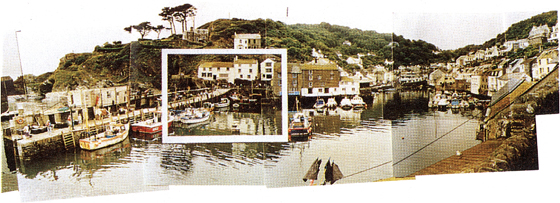
A viewfinder will help to isolate elements of a complex landscape view. The highlighted area is depicted in the drawing below.
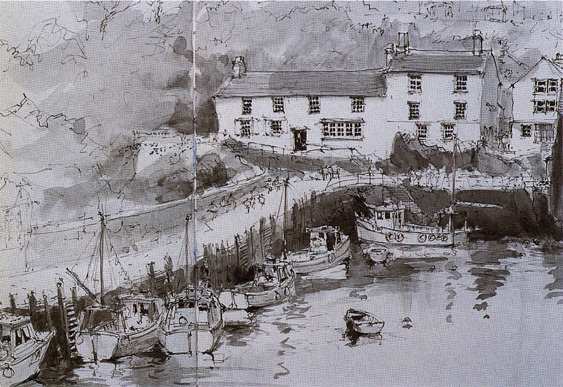
POLPERRO HARBOUR
pen and watercolour, 30 ? 42 cm (75 ? 107 in)
Drawing is a more rapid method of recording the essentials of a subject as the basis for a later studio painting. In this sketchbook drawing I included a monochrome watercolour wash to register the general tonal distribution.
Because our eyes take in an angle of vision of almost 180 degrees we have become accustomed to viewing the world on a wide screen. But painting requires you to focus on the particular, much like a spotlight in a theatre selecting one element of the performance at a time. For landscape work, looking through a viewfinder can be a useful aid. This can easily be made by cutting a 7.5 ? 5 cm (3 ? 2 in) hole in a piece of card which, when looked through at arm’s length, will enable you to see limited areas of the landscape in isolation.
This is useful for dissecting complex subjects, such as in Polperro Harbour. The photograph shows almost the full extent of the elevated field of view I had of a harbour setting. Though there were several subject opportunities here, I was attracted to the particular part of the scene, shown highlighted, by the tonal contrast between the white cottages set against the darker foreground elements, and the dominant angle of the harbour wall, which had the effect of leading the eye into the scene. I made the drawing to record the essential elements of the view. The addition of a monochrome wash also gave a record of the main tonal distribution.
Further opportunities for developing subject matter can be found by using on-the-spot drawings for later studio paintings, or by inventing subjects by combining parts from several drawings.
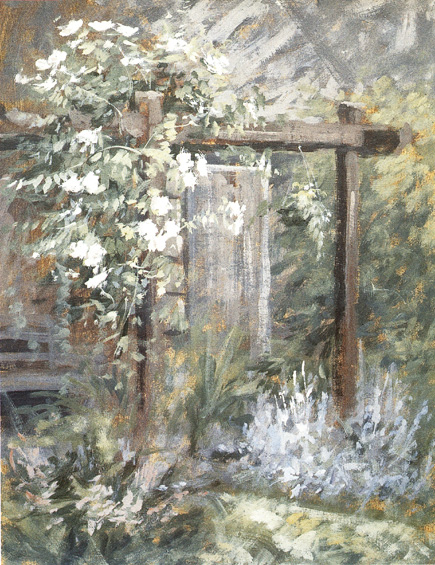
GARDEN CORNER
acrylic, 38 ? 28 cm (15 ? 11 in)
Many suitable subjects can be found in and around the home. This corner of my garden offered a ready-made composition with an amalgam of shapes, patterns and colours.
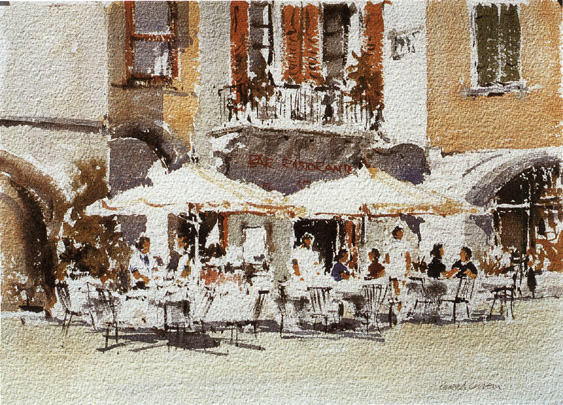
PAVEMENT CAF?
watercolour, 25 ? 36 cm (10 ? 14 in)
This subject focuses on a small corner within a busy area of pavement caf?s. I wanted the painting to portray the essence of the subject as simply as I could without allowing it to become overworked with detail.
Данный текст является ознакомительным фрагментом.