HOW TO POSITION YOUR FOCAL POINT
You should always aim to direct the viewer’s eye into and around the picture. Therefore, the placing of the main elements of the picture is crucial. Artists through the centuries have used the ‘golden section’ – a way of dividing the rectangle that is somewhat complicated, but worth exploring (see Bernard Dunstan’s book Composing your Paintings published by Studio Vista). A simpler way is to divide your rectangle as in either of the diagrams above. Placing the focal point onto one of the ‘eyes’ will be both successful and comfortable.
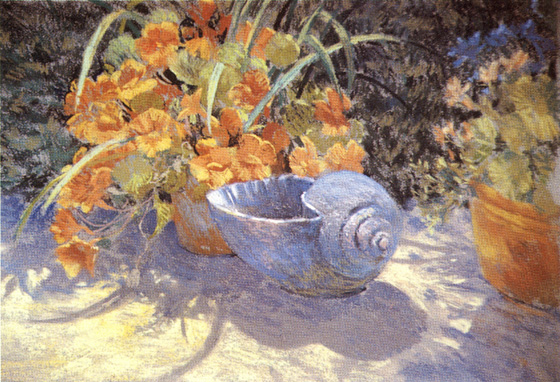
L’ESCARGOT
pastel on paper, 41 ? 51 cm (16 ? 20 in)
Although the shell looks fairly central, in fact I placed it carefully within the rectangle so that its sharply sunlit right-hand edge, and its shadow, were positioned in the lower right focal area of the rectangle. The flowers, in reality, were a different colour – I chose to use orange, the complementary colour to the blue-greys of the iron shell.
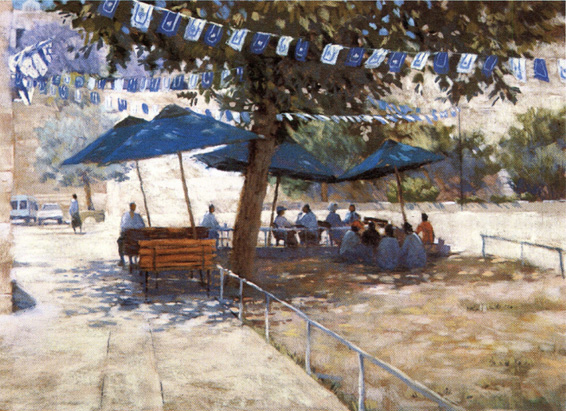
THE HURVA SQUARE CAF?, JERUSALEM
pastel on paper, 51 ? 61 cm (20 ? 24 in)
This was a difficult composition, since the caf? seats stretched across the scene, but I decided on a dominant focal area of the bench, table, silhouetted figures and two umbrellas on the left. The umbrellas are sharply defined by the light area behind. The lines of paving, and the tree trunk, lead to the focal point, about one third into the picture.
Данный текст является ознакомительным фрагментом.