BRINGING SUBJECTS TO LIFE
Another major determinant in subject choice will be your ability and experience in using your chosen painting medium. If you are not adept at painting figures, for example, you will be far less likely to think of using them as possible subjects. But generally, whatever you choose, the best way to get the most from your subjects is to paint them in the most direct way you can. Aim for simplicity, both in your method of painting and means of expression. Do not try to create an exact copy, or produce a photographic likeness of your subjects.
Pavement Caf? illustrates a small corner of a large pedestrian piazza. I selected this area because the patterns of the shapes generated a lively composition, and my aim was to try to catch the essence of the subject with the minimum of detail.
Many of the problems that will confront you when painting can often be resolved by producing preliminary studies, either in monochrome or with limited colours, to help sort out doubts or uncertainties in the interpretation of your subjects. These can be small thumbnail sketches, or larger studies similar to Garden, Malcesine, Italy on page 8. This was produced using one warm and one cool colour to establish the distribution of tonal values, direction of lighting and colour temperature (the relative warm/cool colour relationships) within the proposed image.
Preliminary studies will also allow you to try out different colour combinations in which perhaps you wish to convey mood or atmosphere. In Winter Landscape the mood was achieved by using complementary colours, yellow and purple, which when mixed gave a range of neutral colours tending to grey in the middle. This gave an unusual colour cast to a wintry subject with the inclusion of a warm sky that, combined with using a middle range of tonal values (without the extremes of black and white) gave a more muted feeling to the painting in general.
Atmosphere is obtained principally by adjusting the quality of lighting in a painting. This can have the effect of reducing a subject to just a few simplified shapes. Paintings looking into the light, for example, will dramatically change the elements of a subject into a series of silhouettes.
So, wherever inspiration leads you, opportunities for subject matter exist all around you. All you have to do is to know how to look for them.
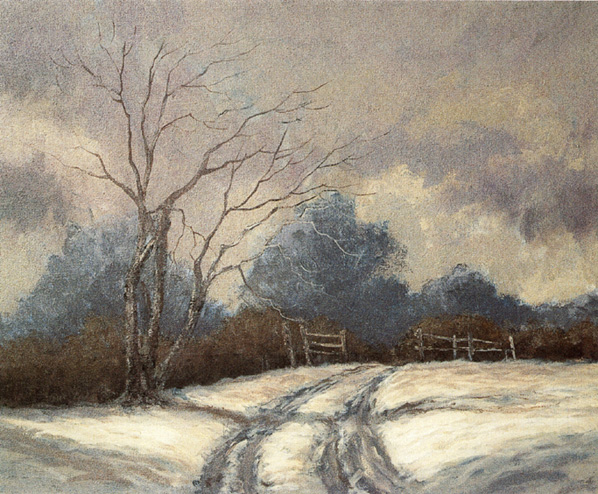
WINTER LANDSCAPE
acrylic, 51 ? 61 cm (20 ? 24 in)
Creating an atmosphere can transform seemingly uninteresting or commonplace landscape subjects. I based this studio painting on a small sketch that I made in the summer months. Closely related tones in combination with a restricted palette of yellow and purple gave a muted mood to the image.
2
CENTRE OF INTEREST
What is a focal point, and do I really need to worry about it unduly?
Answered by: Jackie Simmonds
Many wonderful pictures have been created by artists who have not bothered with a focal point; instead, these pictures tend to be about pattern and texture, a tapestry of shapes and colours. Nevertheless, I believe that a picture will always benefit from having one strong focal point – the centre of interest. A good way to think about a focal point is to create in your mind the picture of a stage full of dancers. The lights are set to wide beam, taking in the whole stage. Your eye darts from dancer to dancer, finding it difficult to concentrate on any one spot on the stage. Now imagine the lights dimming slightly, and a brilliant spotlight shooting out to illuminate one main dancer. Now you have no problem where to look: you are being directed to look in one spot, while your peripheral vision takes in the whole scene.
If you simply sit down to paint whatever is in front of you, without planning the composition, you run the risk of producing a weak picture, one without a sense of purpose. If the subject you select does not have an obvious focal point, you need to consider how to create one. A seascape, for instance, may have no obvious focal point – in fact, the sheer scale of an area of ocean makes it very difficult to focus on one spot – but for the picture to be interesting, the viewer’s eye needs to be held within the rectangle, focusing on one dominant area to begin with, before moving on to examine the rest of the image.
THE MOROCCAN DOORWAY
pastel on paper, 51 ? 30 cm (20 ? 12 in)
Here the viewer’s eye is directed to the doorway by the lines of the pathway. A little obvious, perhaps, but it works well! The doorway is positioned off-centre, and on the top right ‘eye’ of the rectangle. Notice, too, that the edges of the pathway, where they meet the edges of the rectangle, are asymmetrically placed. Positioning them at exactly the same point, to the left and to the right, would have been rather boring.
Более 800 000 книг и аудиокниг! 📚
Получи 2 месяца Литрес Подписки в подарок и наслаждайся неограниченным чтением
ПОЛУЧИТЬ ПОДАРОКДанный текст является ознакомительным фрагментом.